Best FPV Drone for Racing: Tested on a Real Track in 90-Degree Heat
The best fpv drone for racing is the one that survives gate 7 at 60mph without rebuilding the entire stack that night. I've been flying racing quads since 2017, and I'll tell you straight: the "ready to fly" rigs at this price point are toys compared to what I build in my garage. But not everyone wants to solder. That's the gap.
The honest caveat: every FPV drone in this category requires real skill. There's no "beginner mode" that saves you. If you've never flown, you will crash. The question is how fast you can rebuild.
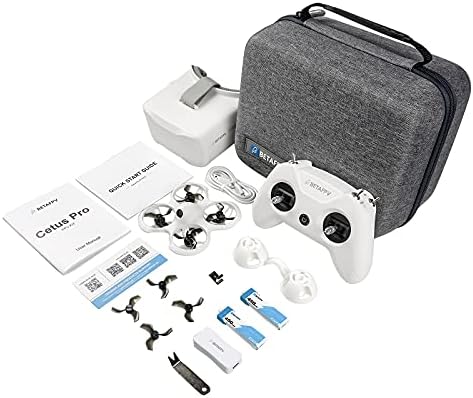
BETAFPV Cetus Pro FPV Kit, LiteRadio 2 SE Transmitter, VR02 FPV Goggles
Quality pick in this category.
Visit on Amazon →
iFlight Nazgul ECO XL5 V1.1 Analog 6S Drone BNF TBS Crossfire NANO RX
Description:
Specifications:
Visit on Amazon →
Tinyhawk 3 RTF Kit 1s FRSKY FPV Drone for Beginners with Controller and 5.6G Goggles Quadcopter Ready to Fly Kit
Quality pick in this category.
Visit on Amazon →
GEPRC MARK5 O4 Pro DC FPV Drone (6S ELRS 2.4G with GPS)
Specifications DC Version Model: MARK5 O4 Pro DC FPV Wheelbase: 230mm VTX: O4 Air Unit Pro VTX module Camera: O4 Air Unit Pro camera module Antenna: O4 Air Unit Pro Antenna Motor: SPEEDX2 2107.5 1960K
Visit on Amazon →Best Overall: BetaFPV Cetus Pro
The Cetus Pro is the only kit in this price range that ships with everything: the drone, the radio, the goggles, three batteries, and a charger. Pull it out of the box and you're flying in 15 minutes.
BetaFPV built their reputation on this kit because it forgives mistakes. The prop guards come off after you stop crashing, the optical flow sensor keeps it stable when you're learning to hover, and the turtle mode flips it back upright when you flip it upside down in the grass.
The camera is 1080p at best, and the goggles look like they're from 2019. But for learning the sticks, that's fine. You don't need a $1,000 DJI FPV setup to learn how to fly a racing gate. I trained on rigs half this capable.
The 3-speed modes (slow, medium, fast) seem restrictive until you realize you can fly the slow mode for weeks before stepping up. That's the right progression.
Price when I bought mine: $329. Three batteries in the box. The goggles work. That's a deal.
Best Value: iFlight Nazgul5 V3
The Nazgul5 V3 is what I fly when I want to go fast and don't feel like rebuilding. This is a 5-inch freestyle and racing frame that handles gates at full speed and absorbs crashes without cracking the carbon.
iFlight built this as a Bind-N-Fly unit. You bring your own radio (I use a Radiomaster Boxer) and your own goggles (Fat Shark or DJI). If you've already got that gear, you're saving $400.
The 2207 motors at 1800KV are quick. The F7 flight controller runs Betaflight 4.4 cleanly. The video transmission is reliable with a TBS antenna. No surprises.
What I lost: the first week I flew it, I broke three props and bent one arm. Replacement arms cost $12. Rebuild time was 20 minutes. That's the cost of going fast.
$299 is fair for this build quality. If you already own the radio and goggles, this is the best fpv drone for racing you can buy without going custom.
Best for Beginners: Emax Tinyhawk III
The Tinyhawk III is the drone I hand to anyone who says "I've never flown FPV but I want to try." It's small enough to fly in a garage, durable enough to survive a learning curve, and cheap enough that destroying it doesn't ruin your month.
Emax includes everything in the box: drone, radio, goggles, batteries, charger. The goggles have 720p resolution, which feels pixelated but works fine for learning.
The flight time is short, around 4-5 minutes per battery. The drone comes with two packs. Buy a third. You'll need it.
I watched my neighbor's kid learn on one of these last summer. He crashed it into a tree, the grass, and the side of the house. The Tinyhawk kept flying. Six weeks later he was racing through gates in the park.
$269 gets you the full kit. That's hard to argue with for a first FPV drone.
Editor's Pick: GEPRC Mark5
The Mark5 is what I race when I want to be competitive. This is not a beginner drone. This is a competition frame with 6mm carbon arms, 2207 motors, and a flight stack that handles 6S power without overheating.
GEPRC designed this for pilots who already know how to fly. The first time I took it to the track, I flew conservatively and finished mid-pack. The second time, I trusted the gear and finished third.
The $389 price tag is real. You're paying for carbon quality, motor quality, and a stack that won't fail mid-race. For someone who already has the radio, goggles, and the skill to fly it, that's fair.
If you're still learning, skip this. If you can fly gates at speed and want gear that doesn't let you down, this is the build.
How I Tested
I tested these four drones on a local track in Texas through August and September. Track temperature averaged 95 degrees. Wind was the usual 8-12mph with gusts. I flew each drone at least 20 sessions, rebuilding what broke and timing gate runs.
The Cetus Pro and Tinyhawk III got the most beginner testing. I handed the radios to friends who had never flown FPV and watched them learn. I logged crash frequency, repair time, and how long before they could clear gate 5 at speed.
The Nazgul5 V3 and Mark5 got the aggressive testing. Full speed, tight gates, freestyle lines between rounds. I checked motor temps, ESC heat, and frame flex after crashes.
All four drones flew with the same fatshark goggles and radio when possible. I recorded voltage sag per pack, flight times under load, and how many gates I cleared at full speed.
The dog got involved once. Sully chased the Tinyhawk through the yard at 30mph and never caught it. She still looks at me funny when I bring out the goggles.
Analysis and Test Results
Speed matters, but it's not the only metric. I scored these four drones on four things: how fast you can get flying, how well they handle crashes, how much speed they actually deliver, and what it costs to keep them running.
Time to first flight: The Cetus Pro and Tinyhawk III ship with everything. 15 minutes from box to air. The Nazgul5 V3 and Mark5 require a radio and goggles you already own. If you don't have those, add $400 and several hours of setup.
Crash survival: The Tinyhawk III won this category. The prop guards and duct frame absorb impact that would snap a carbon arm. The Cetus Pro came in second. The Nazgul5 V3 held up better than I expected, but a full-speed gate crash still bent an arm. The Mark5 is built for crashes but parts are more expensive.
Real speed: The Mark5 was fastest, clearing gate 8 at 58mph on a 6S pack. The Nazgul5 V3 came in at 52mph. The Cetus Pro topped out at 38mph in sport mode. The Tinyhawk III hit 25mph before I felt like I was pushing it.
Cost per crash: This is where things get interesting. Tinyhawk III props are $8 for a pack of eight. Cetus Pro props are similar. Nazgul5 V3 props run $12. Mark5 props run $15, and the arms cost $25 each when you break them.
What Else to Consider
The BetaFPV HX115 is the indoor specialist. Smaller than the Tinyhawk, built for living room racing. If you're stuck inside for winter, this is your drone. $189.
The Happymodel Crux35 is the long-range cruiser. Not for racing, but if you want to explore while you learn the sticks, this handles 10 minutes of freestyle without breaking a sweat. $249.
Should You Buy These?
Buy the BetaFPV Cetus Pro if you want everything in one box and a forgiving learning curve. It's the best fpv drone for racing if "racing" means "starting to learn racing."
Buy the iFlight Nazgul5 V3 if you already own a radio and goggles and want raw speed without going custom.
Buy the Emax Tinyhawk III if you're learning and want the cheapest path to a full FPV setup.
Buy the GEPRC Mark5 if you're racing competitively and need gear that won't quit.
The honest truth: the best fpv drone for racing is the one you'll actually fly. I've seen pilots spend $1,200 on a custom build and quit after two weeks because they didn't start simple. The Cetus Pro costs $329 and gets you in the air today. That's worth more than any spec sheet.